
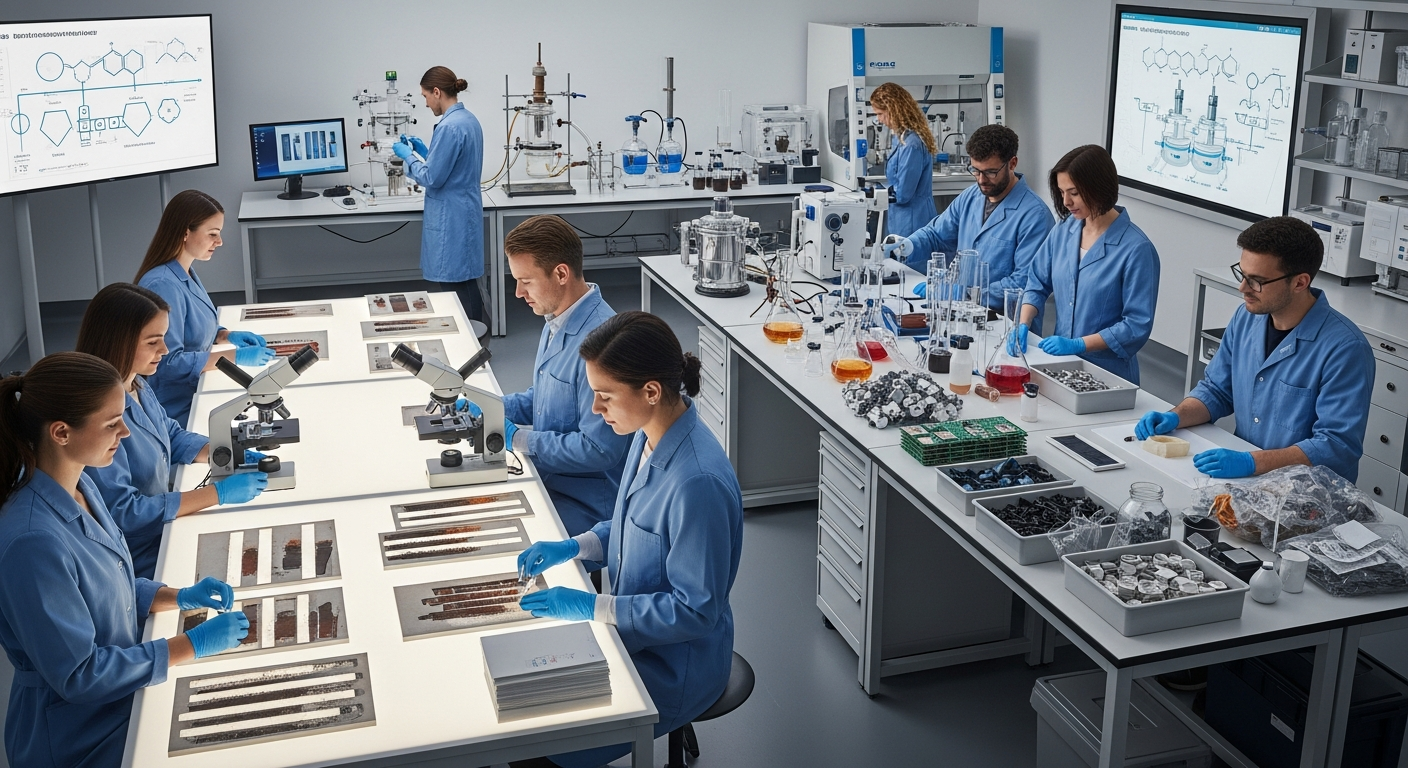
McDermitt Caldera’s claystone lithium presents unprecedented technical challenges that battery recycling can solve through workforce development and process innovation. While mining proponents focus on extraction capacity, the success of Thacker Pass depends on mastering hydrometallurgical processes never before applied to claystone at commercial scale. Recycling operations provide the technical foundation for mining success by creating skilled workforces, proving processing technologies, and building rapid deployment recycling facilities that demonstrate chemical expertise essential for claystone processing.
Claystone Processing: Unproven Technology at Commercial Scale
Thacker Pass represents the first commercial-scale attempt to extract lithium from claystone using hydrometallurgical processing, creating technical risks that recycling experience can mitigate. According to NAI 500’s technical analysis, the project will employ a sulfuric acid leach flowsheet that “behaves differently than brines or hard-rock spodumene” and requires precise control of particle size distribution, slurry density, temperature, and residence time.
The Department of Energy’s $2.26 billion loan commitment to Lithium Americas reflects confidence in the technology, but downstream purification processes remain sensitive to pH, redox conditions, and impurity loading. Process variability can push product off-specification, requiring advanced process control systems and real-time analytics to maintain commercial viability.
Claystone extraction involves crushing volcanic sediments into slurries, separating non-lithium materials, and treating lithium-bearing clay with sulfuric acid to extract the metal. Unlike conventional hard-rock mining or brine evaporation, this process has no commercial precedent in the United States, creating workforce training challenges that recycling operations are uniquely positioned to address.
The technical complexity extends beyond extraction to processing facility design. Thacker Pass will require specialized equipment for handling corrosive slurries, managing sulfuric acid systems, and controlling environmental emissions from clay processing. These challenges parallel those faced by advanced recycling facilities, creating skill transfer opportunities between the sectors.
Hydrometallurgical Expertise: Recycling as Training Ground
Battery recycling operations provide essential training in hydrometallurgical processes that directly transfer to claystone lithium extraction. NREL’s technical analysis demonstrates that recycling facilities employ the same chemical processing methods required for claystone processing, including acid leaching, precipitation, solvent extraction, and electrolytic deposition.
Current recycling operations process “black mass” from spent batteries using hydrometallurgical techniques nearly identical to those required for claystone processing. Workers trained in managing corrosive chemical systems, controlling pH and temperature parameters, and handling hazardous materials develop expertise directly applicable to mining operations.
The DOE’s ReCell Center advances recycling technologies that support mining workforce development through process innovation. Direct recycling methods being developed maintain material structure while extracting value, requiring sophisticated chemical control similar to claystone processing requirements.
Nevada currently employs over 20,000 workers across the lithium supply chain, with job growth at twice the national rate. This existing workforce provides a foundation for claystone processing development, but requires specialized training in new extraction methods that recycling facilities can provide through operational experience.
Workforce Development Through Operational Experience
Thacker Pass construction will employ 1,800 skilled workers at peak construction and 360 in operations, requiring advanced training in chemical processing, environmental monitoring, and safety systems management. Recycling facilities offer immediate opportunities for workers to develop these skills while mining projects advance through development phases.
The technical skill sets overlap substantially between recycling and mining operations. Chemical engineers, process technicians, environmental specialists, and maintenance personnel require similar expertise in both sectors. Training programs that begin with recycling operations create ready workforces for mining expansion while providing immediate employment opportunities.
Bechtel’s construction management approach includes a dedicated Workforce Hub providing housing and services for up to 2,000 construction workers, demonstrating the logistical complexity of developing remote processing facilities. Recycling operations that successfully manage similar workforce challenges provide templates for mining project execution.
The integration of workforce development programs between recycling and mining creates career pathways that support long-term industrial development. Workers can begin careers in recycling operations, develop advanced technical skills, and transition to higher-paying mining positions as projects reach operational status.
Process Innovation: From Battery Chemistry to Claystone Extraction
Advanced recycling technologies being developed for challenging battery chemistries provide direct technical benefits for claystone processing. NREL’s collaboration with industry partners focuses on lithium iron phosphate (LFP) recycling, which presents similar challenges to claystone processing in handling low-value materials with complex chemistry.
NREL researcher Andrew Colclasure explains that current hydrometallurgical methods must demonstrate “efficient processes that also recycle low-value materials such as graphite and iron phosphate into commercially viable products.” This challenge mirrors claystone processing requirements to extract lithium economically from complex clay matrices containing multiple minerals.
Emerging electro-hydrometallurgical technologies combine chemical processing with electrochemical techniques to achieve more selective material recovery. These innovations, developed for battery recycling, apply directly to claystone processing challenges where selective extraction improves process economics and reduces waste generation.
The development of closed-loop processing systems in recycling operations provides blueprints for environmental compliance in mining applications. Advanced facilities achieve minimal waste generation through comprehensive resource recovery and energy optimization, demonstrating approaches essential for claystone processing environmental permits.
Technology Transfer: Proven Methods Supporting Innovation
Recycling facilities operating today demonstrate the technical feasibility of complex hydrometallurgical processes at commercial scale, providing confidence for claystone processing development. Closed-loop battery recycling systems achieve 95% material recovery rates through proven chemical processes scalable to mining applications.
The technical challenges of processing mixed battery chemistries parallel those of claystone extraction from heterogeneous clay deposits. Recycling operations successfully manage variable feedstock composition, optimize chemical usage, and maintain product specifications despite input variability—capabilities essential for claystone processing success.
Automation systems developed for recycling operations transfer directly to mining applications. Process control systems that monitor chemical reactions, adjust parameters in real-time, and maintain safety standards address the same technical challenges identified for claystone processing by Emerson’s automation systems at Thacker Pass.
Environmental monitoring and compliance systems developed for recycling facilities provide templates for mining operations. Air emissions control, water treatment systems, and waste management protocols proven in recycling operations reduce technical risks for claystone processing facility development.
Risk Mitigation Through Parallel Development
Developing recycling capacity alongside mining projects provides risk mitigation that protects investment while building technical capability. Recycling operations can validate processing technologies, train workforces, and demonstrate environmental compliance methods before mining projects reach full production.
The technical complexity of claystone processing creates execution risks that recycling experience can reduce. Process optimization, equipment selection, and operational procedures developed in recycling facilities provide proven approaches for mining project implementation, reducing startup risks and improving project economics.
Regulatory compliance requirements for both recycling and mining operations involve similar environmental monitoring, safety protocols, and waste management systems. Experience gained through recycling facility permitting and operations provides regulatory expertise that supports mining project approval and implementation.
Market volatility affects both recycling and mining economics, but domestic supply chain security improves when multiple processing pathways operate simultaneously. Recycling capacity provides material supply during mining development phases while offering alternative revenue streams during commodity price fluctuations.
Federal Investment Synergies
Federal funding programs increasingly recognize the synergies between recycling and mining development, with the DOE’s $2.26 billion Thacker Pass loan complementing recycling technology development initiatives. These parallel investments create opportunities for coordinated workforce development and technology sharing that benefit both sectors.
The ReCell Center’s $5.5 million American-Made Battery Recycling Prize provides vouchers for teams to access national laboratory facilities, creating research partnerships that advance both recycling and mining technologies. Technical innovations developed through these programs support both current recycling operations and future mining projects.
Nevada’s Lithium Loop initiative demonstrates state-level coordination between mining and recycling development, emphasizing workforce training and technology transfer. This integrated approach maximizes federal and state investment returns while building comprehensive industrial capability.
Project labor agreements at Thacker Pass prioritize employment of local and regional skilled craft workers, including Native Americans and residents of under-represented communities. Federal consultation requirements increasingly emphasize community benefit and environmental justice, creating policy advantages for projects that demonstrate comprehensive workforce development.
Conclusion: Recycling as Mining Success Foundation
McDermitt’s technical challenges require proven hydrometallurgical expertise that recycling operations provide through workforce development, process innovation, and technology transfer. Rather than competing with mining development, recycling creates the technical foundation for mining success by training skilled workforces, validating processing methods, and demonstrating environmental compliance approaches.
The economic logic supports integrated development: recycling investments reduce mining technical risks while providing immediate employment and material supply. Workers trained in recycling operations possess the chemical processing expertise essential for claystone extraction success, while recycling facilities demonstrate the process control capabilities required for complex clay processing.
Success requires recognition that technical innovation and workforce development are complementary across both sectors. Recycling operations that advance hydrometallurgical processing create capabilities essential for mining while providing immediate economic benefits that support community stability during mining development phases.
The $2.26 billion federal investment in Thacker Pass justifies comprehensive technical preparation that recycling can provide through immediate deployment, workforce training, and process validation. Recycling infrastructure supports mining success through technical expertise development and risk mitigation that protects mining investments while advancing domestic critical materials capability.


